Is Play 2 Win Casino Safe? Terms, Complaints and Risk Signals
 Available in US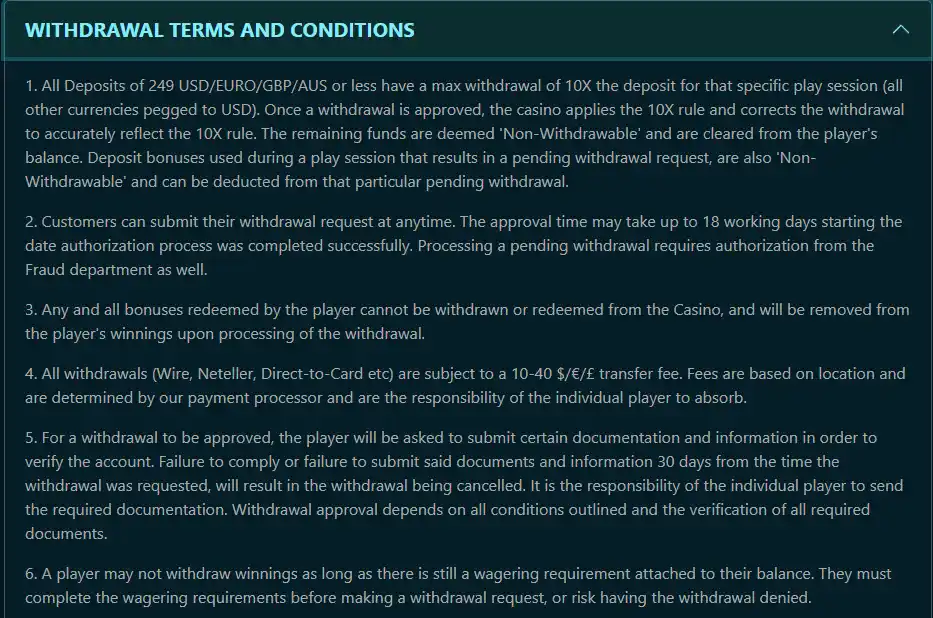
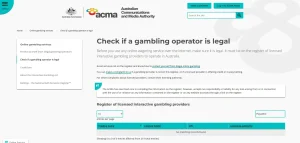
Play 2 Win has several material risk signals that deserve more weight than a generic “safe” or “unsafe” label. Its official Terms state that the casino is licensed in Curaçao, but Play2Win, Play 2 Win, Cyberrock and Cyberrock Entertainment do not appear in ACMA’s current register of Australian-licensed interactive gambling providers. Separately, Casino Guru currently gives Play2win a 1.9/10 Safety Index labelled “Very low”, while Wizard of Odds blacklists the casino. Those are third-party editorial judgments and are attributed here as such.
The official Terms add concrete issues a reader can evaluate independently: deposits of 249 AUD or less are subject to a 10x cashout cap for that play session, withdrawal approval can take up to 18 working days after successful completion of the authorisation process, an account balance can be forfeited after 120 days without login or wagering, and complaints are expected in writing within five days of the event. Those clauses are more useful than a one-word verdict because they show where the practical risk sits.
Table of Contents
- Trust assessment at a glance
- Layer 1: what the official Terms say
- The dormant-account clause deserves attention
- The complaint window is unusually important
- KYC is relevant, but it is not a safety certificate
- Layer 2: Curaçao licence wording versus Australian authorisation
- Layer 3: what Casino Guru’s 1.9/10 rating means
- Layer 3 continued: Wizard of Odds blacklist
- Layer 4: complaints and payout themes
- Australian context changes the trust question
- Details that need separate verification
- How to weigh the evidence
- Sources
- Bottom line
- Is Play 2 Win Casino Safe? Terms, Complaints and Risk Signals
Trust assessment at a glance
| Evidence layer | What is verified | Why it matters |
|---|---|---|
| Official Terms | 10x low-deposit cashout cap, up to 18 working days for withdrawal approval after authorisation, 120-day dormant-balance rule, five-day complaint window, withdrawal verification provisions | These are contractual rules that can directly affect access to winnings, timing and dispute handling. |
| Licence and Australia status | The Terms state a Curaçao licence jurisdiction; no Play 2 Win or Cyberrock match is present on ACMA’s current Australian register | A foreign casino-licence claim is a different fact from Australian authorisation. |
| Third-party assessment | Casino Guru: 1.9/10 Safety Index, “Very low”. Wizard of Odds: blacklisted | These are independent editorial risk assessments, not regulator findings. |
| Complaint signal | Multiple complaint sources discuss payout and withdrawal disputes, but their totals and classifications differ | The recurring themes are more useful than presenting one unstable complaint count as definitive. |
Layer 1: what the official Terms say
The strongest trust analysis starts with the operator’s own current Terms because these rules define what the casino says it can do. The most material clause for small deposits is the cashout rule: deposits of 249 AUD or less have a maximum withdrawal of 10 times the deposit for that specific play session. The Terms also say that once a withdrawal is approved the casino applies that rule and clears the remaining funds as non-withdrawable.
This is not a bonus-only rule. It sits in the withdrawal section and is tied to the size of the deposit for the play session. That distinction is important when comparing it with ordinary bonus wagering conditions. A player could satisfy a wagering requirement and still face a separate cashout limit if the low-deposit rule applies. The dedicated withdrawal limits and timing page breaks down that banking mechanic without turning this trust page into a second withdrawal guide.
Timing is another material term. The current Terms say customers can submit a withdrawal request at any time, but approval may take up to 18 working days starting after the authorisation process has completed successfully. The wording does not mean every withdrawal takes 18 working days, and it does not define the processing time of every payment method. It does establish that the published approval window can extend well beyond a few business days.
The dormant-account clause deserves attention
The Terms state that if a player does not log in for 120 days, or passes 120 days without making a wager, the casino is entitled to the balance and may forfeit it. The same clause says later withdrawal requests can be examined case by case while reserving the right to invoke the four-month rule.
For a trust assessment, the key point is not whether a reader expects to leave an account inactive. It is that the published rule can affect the entire remaining balance after a relatively short inactivity period. That makes account inactivity a financial condition to monitor, not just an administrative status.
The existence of the 120-day clause comes directly from the official Terms. That makes it possible to assess the rule without relying on a third-party site’s characterisation of the casino.
The complaint window is unusually important
Play 2 Win’s Terms say that a complaint, grievance, technical complaint or dispute must be submitted in writing within five days of the event. They also say the casino can decide not to address a complaint received after that period, while allowing case-by-case exceptions for extenuating circumstances.
That is a short procedural window. A reader who has a transaction or game dispute should therefore keep dated records and read the current complaint wording promptly rather than assuming a long informal escalation period. The contractual clause should be read alongside any law that applies to the individual situation.
The separate Play 2 Win complaints page compares dated case themes, outcomes and source methodologies. Those details are more useful than reducing several databases to one cross-platform complaint total.
KYC is relevant, but it is not a safety certificate
The Terms allow Play 2 Win to request documentation and information to verify an account before approving a withdrawal. The current verification language also gives examples such as photo identification and proof of address. This is a normal type of account-control mechanism in online gambling, but the existence of KYC should not be used as proof that every other term, licence statement or complaint issue is favourable.
The more useful question is whether verification requirements are communicated clearly and applied consistently with the published withdrawal terms. The Terms do not specify an exact KYC processing time, so the separate up-to-18-working-day withdrawal approval clause should not be treated as a document-verification timeframe.
Layer 2: Curaçao licence wording versus Australian authorisation
Play 2 Win’s official Terms state that the casino is registered, licensed and regulated in Curaçao for operating an online casino. The available primary-register evidence does not establish a current Play 2 Win licence number or expiry date.
Australia is a separate regulatory question. The current ACMA register has been checked for Play2Win, Play 2 Win, Cyberrock and Cyberrock Entertainment with no matching entry. ACMA explains that its register covers Australian-licensed interactive gambling or wagering providers. The deeper Curaçao licence and ACMA status page documents that distinction and the aliases used in the register check.
These facts should not be collapsed into a claim that a foreign licence automatically creates Australian authorisation. Nor should the local-licence status be used to hedge unrelated facts about games, payments, support or mobile access. Licensing is one evidence layer with its own scope.
Layer 3: what Casino Guru’s 1.9/10 rating means
Casino Guru currently displays a Safety Index of 1.9/10 for Play2win and labels it “Very low”. That score is Casino Guru’s editorial assessment, not a regulator rating or an objective certification.
That rating is not a regulator score, a financial audit or a guarantee that every individual player will have the same experience. It is Casino Guru’s editorial assessment produced under its own methodology and is most useful when compared with the operator’s actual Terms.
One useful cross-check is the low-deposit maximum-win rule. Casino Guru highlights the 10x cap as a negative factor, while the current official Terms independently show the rule. The third-party criticism therefore points to a clause that can be verified directly rather than relying only on a review site’s characterisation.
Layer 3 continued: Wizard of Odds blacklist
Wizard of Odds currently describes Play2Win as blacklisted and attributes that status to player-unfriendly terms together with payout complaints. The official 10x low-deposit cashout rule and the published withdrawal-approval window provide direct Terms evidence that can be weighed alongside that third-party judgment.
Again, “blacklisted” is the publisher’s classification, not an ACMA enforcement label. Wizard of Odds identifies concerns that can be compared with official contract wording and complaint reports, and its judgment should remain clearly attributed to that publisher.
Layer 4: complaints and payout themes
Complaint evidence should be handled with more care than a raw total. Different review and dispute platforms count complaints differently, include different date ranges, and may classify related-brand cases in different ways. Casino Guru’s current complaint presentation is not consistent enough to support one stable total, so readers should focus on dated cases, outcomes and recurring themes.
The recurring theme across external sources is more informative: withdrawal delay, reduced or limited cashouts, disputed winnings and communication around payout decisions. Those themes are consistent with why the operator’s own withdrawal clauses matter. They do not prove that every withdrawal will result in a dispute, but they make the contractual limits and timelines especially relevant when assessing risk.
A reader should also distinguish a resolved complaint from an unresolved one, a forum post from a mediated case, and a complaint allegation from a regulator finding. Mixing those categories can make the evidence sound stronger than it is.
Australian context changes the trust question
ACMA’s current guidance says the Interactive Gambling Act makes it illegal for gambling providers to offer certain online services to people in Australia and lists online casinos among the banned services. It separately maintains the register of Australian-licensed interactive wagering providers. This is why an Australian reader should not treat a Curaçao casino-licence statement as equivalent to inclusion in the Australian register.
The broader federal framework, including the distinction between prohibited online casino services and licensed wagering categories, belongs on the Australian online casino law page. The regulatory context shows why licence jurisdiction and Australian authorisation need to be assessed as separate evidence layers.
Details that need separate verification
- The exact Play 2 Win Curaçao licence number and expiry require confirmation from a current primary register.
- The current evidence does not establish Australian licensing or Australian dispute-resolution coverage.
- SSL quality, two-factor authentication and a current named RNG certification require separate current evidence before they can be used as safety signals.
- Casino Guru’s complaint presentation should be checked by date and case status rather than reduced to one unstable total.
- The Terms do not specify a fixed KYC processing time.
How to weigh the evidence
- Start with the Terms. The 10x low-deposit cashout cap, 18-working-day approval window, dormant-balance clause and five-day complaint window are directly published rules.
- Separate licence jurisdictions. A Curaçao licence statement and an Australian register entry are different things.
- Use third-party ratings as opinions with methodology. Casino Guru’s 1.9/10 score and Wizard of Odds’ blacklist are meaningful signals because their concerns overlap with verifiable Terms, but they remain publisher assessments.
- Read complaints for patterns, not just totals. Focus on what happened, the disputed issue, how the operator responded and whether the case was resolved.
- Do not let one positive feature cancel a material contractual term. Game selection, payment support or mobile access answer different questions from withdrawal fairness and regulatory status.
Sources
- Play 2 Win Terms and Conditions for withdrawal, complaint, dormant-account, KYC and Curaçao wording.
- ACMA register of licensed interactive gambling providers for the Australian register check.
- ACMA Interactive Gambling Act guidance for the Australian online-casino regulatory category.
- Casino Guru Play2win review for its current Safety Index and methodology-based assessment.
- Wizard of Odds Play2Win review for its blacklist classification and stated rationale.
Bottom line
The evidence does not support a reassuring one-word safety verdict. Play 2 Win publishes several terms that can materially restrict or delay access to money, including the 10x low-deposit cashout cap, the up-to-18-working-day withdrawal approval clause and the 120-day dormant-balance rule. Casino Guru’s current 1.9/10 “Very low” Safety Index and Wizard of Odds’ blacklist add negative third-party signals that overlap with those published terms.
At the same time, the distinction should stay precise. Play 2 Win states a Curaçao licence jurisdiction, while the available primary-register evidence does not establish a current licence number, and the brand is not present under the checked names in ACMA’s Australian register. Treat those as separate facts, keep third-party judgments attributed, and use the full Play 2 Win Australia review for the broader product and risk context.